

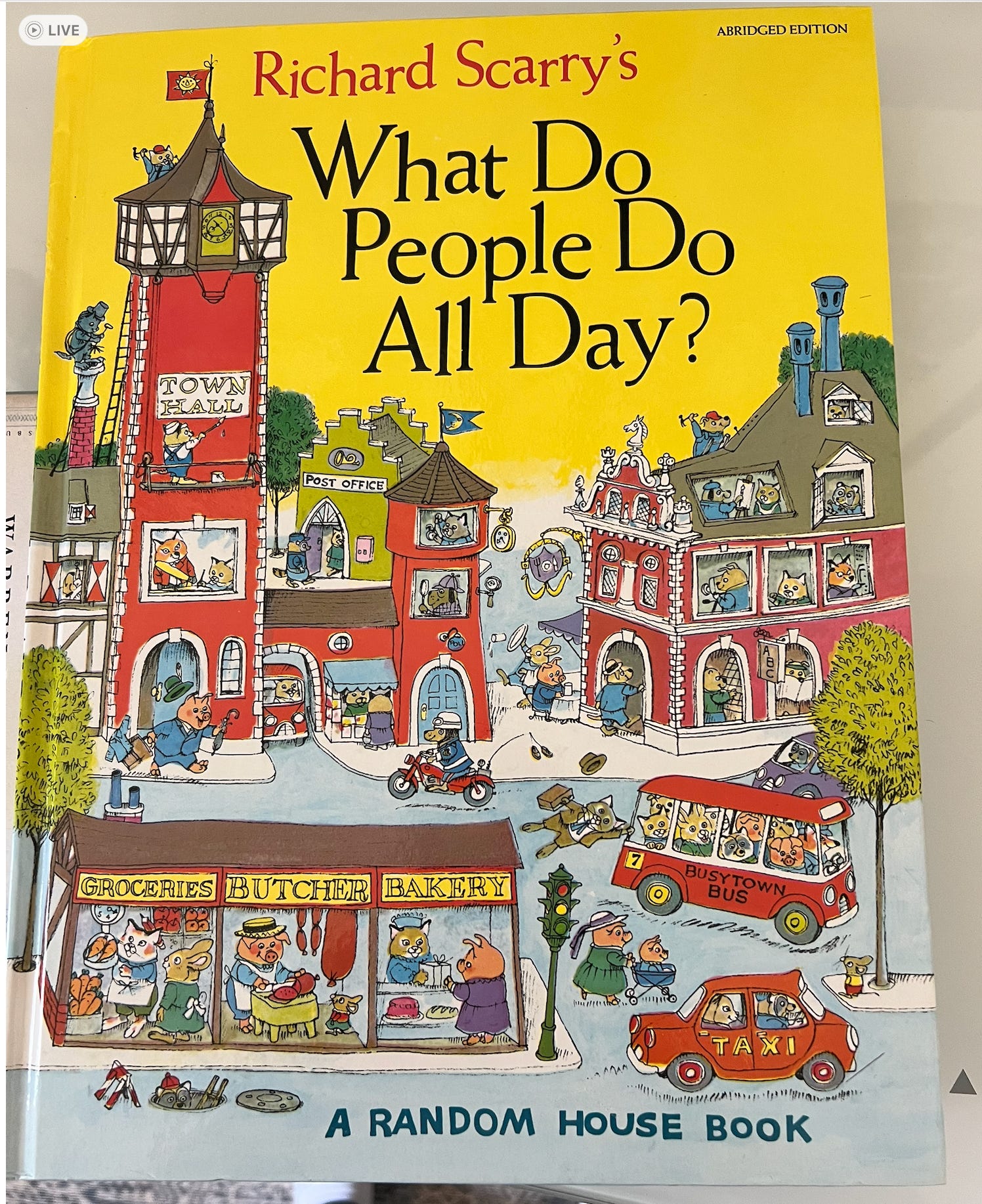
I have often wondered what people do all day. When my kids were little, we read the official manual: Richard Scarry’s What Do People Do All Day? Lately, I have more time to do things I actually want to do, and I have been thinking about what made that possible. There is a practical experiment below, but it starts with paying attention to the day we are already living.
It feels good to know.
As I made my way through my career, and especially when I got my first mentor, I began taking this question seriously. I used to say I had deliverables, not working hours. Really, that was a lie. I was a complete workaholic, caught up in the culture of efficiency and productivity.
I worked in a company that spanned 175 countries and employed 350,000 humans. There was always someone awake to talk to. I learned to create work for myself and others. To my credit, it was usually work someone would pay for. But I became very good at making more of it.
Today, I have more respect for the thinking that takes time and effort. Working through something difficult can give me clarity and the confidence that I can work through it again.
I think I have used over 100 frameworks to understand how I spend my time. There is a seasonality to it. Every winter, fall, spring and summer, I tend to revisit what I want my days to look like and what I want to achieve. Learning how I learn, and being intentional with my time, is a gift I can give myself. The unexamined life and all.
Having spent most of my career working with data, analytics, and AI, you might think I would have a pretty good answer by now.
Some days I do. Some days I cannot remember what I did yesterday.
It is a practice, not a destination. AI has made that practice more complicated for me, even as it offers new ways to help.
We now have AI systems that can read our calendars, search our messages, and summarize months of activity in seconds. I understand the appeal. I love collecting data. Sometimes I call it ‘organizing’ the work so I can procrastinate doing the work. But when an AI organizes and labels our activity, it is working from the context available to it. That may leave out what I was thinking, what I chose not to do, or what happened when the meeting paused. Even a timestamp cannot tell the whole story.
The midden problem
Someone on a team I worked with recently asked the AI assistant built into her email and calendar to review nine months of meetings and messages and tell her where her effort went. It returned work categories, percentages, and “specific bodies of work to back those numbers up.” It counted and classified and made choices.
She shared the method with her team, but she did not share the results.
When I asked her about it, she said she could not tell whether they were really true. The meetings were there, but where were the hours in prep? The followup? The meeting before the meeting or scarfing food and deploying makeup for the zoom call in record time?
The results from the AI had the shape of an answer, but she couldn’t tell how much of her actual work it described.
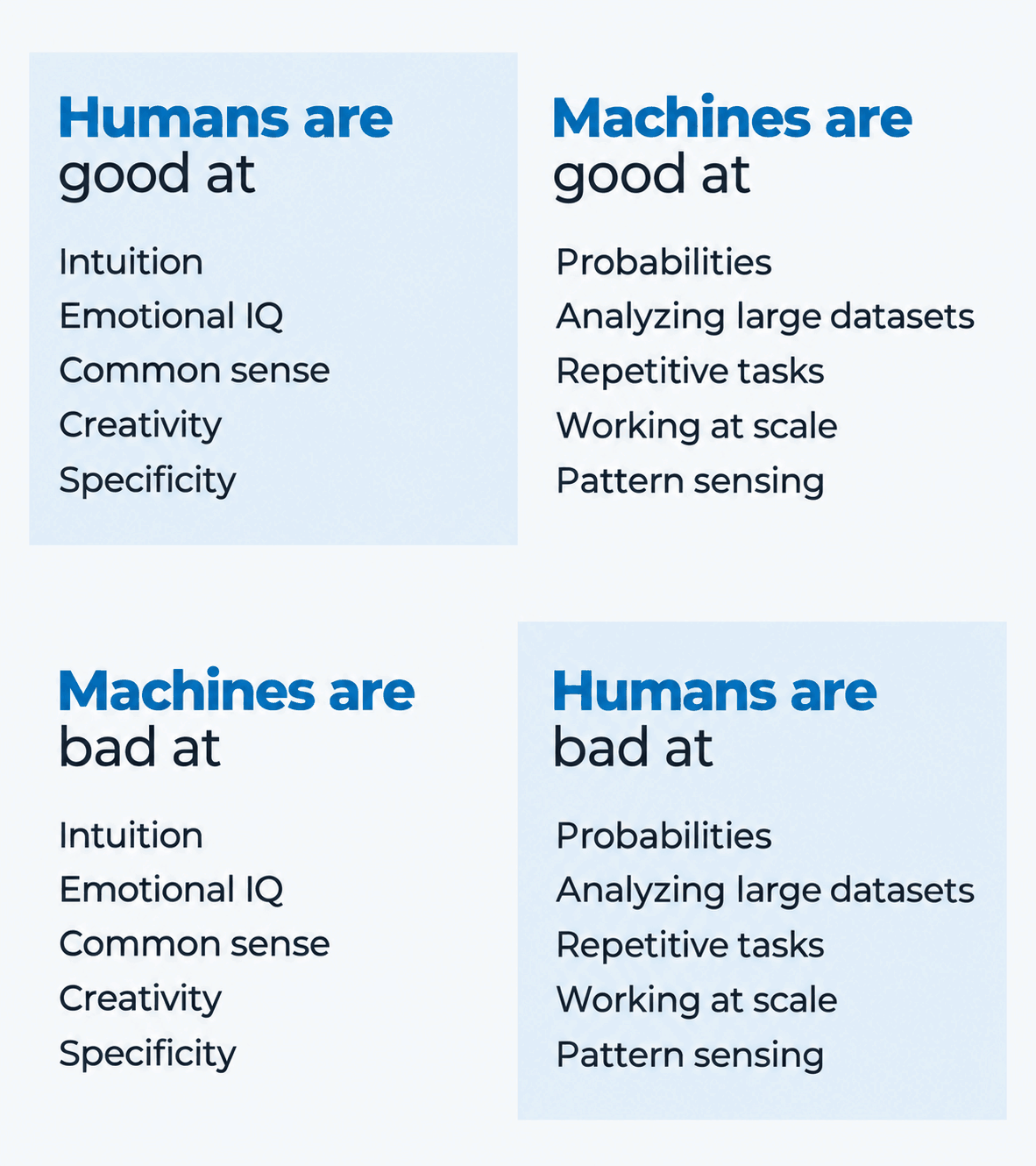
Archaeologists have a word for the accumulated refuse of a settlement: a midden. Fish bones, broken pots, ash, shells. I spent years learning to read these traces of people’s lives. They can tell us a great deal, but interpretation requires explicit context, and for an archaeologist - most of that context is literal dust in the wind. For us, right here and right now, some of that context is still available. We can add it. AI can help us gather the traces, and we can bring our experience to interpreting them. I use a version of the graphic below in my keynotes to start a conversation about what each of us brings to that partnership.
Your calendar is a midden. So is your sent folder. The meeting invitation, the document, the reply-all: each is something left behind by work. It is not the actual work.
An AI can help you find and sort those artifacts. But a count of messages is a count of messages. Turning it into a claim about attention, contribution, or value requires evidence and context that may be missing from the pile.
The afternoon you spent thinking, furiously typing and then deciding not to send an email will not leave an artifact for the AI to count. A problem you quietly helped a colleague solve might appear under somebody else’s name. A document generated in seconds might sit beside one that took weeks of difficult thought.
And even a faithful account of what happened would leave another question: did the system make it possible for that work to accomplish anything? Let’s take a deeper dive into what I define as a management problem, courtesy of the great Dr. Deming.
The management problem
I urge you to take the time to really watch this 7 minute video of his Red Bead Experiment, it makes me hitch my breath when I realize how many times I have done the best job ever, and it still doesnt matter.
In the demonstration, workers use a paddle to draw beads from a container holding a mixture of red and white beads. White beads are acceptable output. Red beads are defects. The workers must follow the prescribed process, and management judges their results.
Some draws contain more red beads than others. Management praises, criticizes, and demands improvement, although the workers cannot control the mixture or redesign the process.
The demonstration exposes how easily we attribute the results of a system to the people working within it. The workers want to succeed. Better results require changes to the conditions producing those results. The Deming Institute explains the experiment here if you want more.
I keep thinking about how it feels to be told to do better when you have no meaningful way to change what happens. I know how exhausting that can be. After a while, it becomes hard to believe that your effort will make a difference.
You can care deeply. You can work hard. You can follow every instruction and still be unable to achieve the number.
Deming placed responsibility for the system with management. That responsibility includes giving people the opportunity and methods to improve the work, rather than blaming them for conditions they cannot change. Goodness, that sentence is easier to type than to put into practice. Watching Deming, I am also struck by the time he gives people to experience the lesson. He lets them participate and notice what happens. I want us, as leaders, to make more room for that kind of learning.. Imagine a company today putting the entirety of the team in an auditorium to make a simple point - it is time we leaders illustrate slowing down and thinking about how to teach humans.
I worry that AI will make it easier to overlook this.
We can produce more reports, classify more activity, and generate more “confident sounding” assessments of people without understanding whether they have the conditions to succeed.
If I assess a developer on how quickly they close tickets, I create an incentive to find, or create, small tickets they can close quickly. People want to do a good job. They want the good grade. But the number of tickets closed can improve while the code never gets shipped.
Add AI, and we may get much faster at generating tickets, closing them, and writing beautiful summaries of our progress.
We still have to ask whether the work accomplished what we needed it to.
Deming’s willing workers wanted to succeed. Our responsibility as leaders is to examine whether the process and the measures give people a meaningful way to do that. We have to be willing to change both.
And that brings me back to understanding what we do all day. Before we can improve the conditions around our work, we need some way to notice them.
This is where I stopped writing the original version of this post.
I had an exercise. Pick yesterday. Write down what you did. Map it to a goal or a measure. Find the gaps.
Then I tried it and could not remember yesterday.
I once created a Slack channel to record when I stopped one task and started another. It drove me nuts. Meredith and I now meet at the end of the day to review our meetings and what we did so we can update our LLM Wiki. Even with that intention and another person helping me remember, we miss things and we are still learning and experimenting - nothing feels done because done is not the destination.
Documenting work is work. Learning a new tool is work. Trying to learn a tool while also inventing the process for using it is a lot to ask of someone who already has a job and wears many hats.
So I want to offer an experiment that matches my seasonality.
The experiment
Once a quarter, choose a week to pay attention to what you do all day. Use AI to help collect the traces each day, then add your own words and correct any labels that do not fit. Save the broader review for the end of the week.
A week will give you a sample. It will have gaps, and you may need to adjust how you collect things as the tools change. It may turn out to be an unusual week. That is something to learn from, too. The point is to practice.
Start with whatever your AI system can actually access: calendar entries, sent messages, meeting notes, slack messages, documents you worked on, and things you created with AI. Ask for dates and links so you can inspect what it found. Ask it to make the gaps visible.
Then add what you know. Use your own words to describe what happened, and change any categories that do not fit your experience.
You can write it down. You can dictate it. You can make it yesterday if the end of today is already too much. Here are some from my yesterday:
“I spent an hour preparing for that conversation with an AI and it felt like it did a good job until I realized that I should have read the material myself.”
“We made a draft with AI, but I still need to check whether it answers the question our client asked and now I have 4 more research threads to chase down.”
“I was waiting for a decision, an output, a screen to test, so I moved to something else and lost 20 mins to a blog that distracted my attention. I then spent 5 mins asking my utilities AI to show me how to turn off notifications (again).”
“My daughter interrupted the meeting coming home with her friends screaming with excitment about a boy. It turned out to be a good tension release to a tough meeting and we got some comic relief. I made a silent note of gratitude that I get to work in a workplace that I can share her utterly human joy in the middle of the workday.”
If we are going to call this metadata, let’s make room for the fact that we are humans.
We switch contexts because a colleague needs help, a customer has a problem, a child walks into the room, or a decision arrives three hours after we needed it. Some interruptions are avoidable. Some are part of a life I would like to keep living.
I want to understand the context I am working in well enough to make a reasonable decision about what needs my attention. For this week, I want to resist judging every entry or rearranging my schedule to appear more productive. The week is about noting, not concluding.
Then, at the end of the week, look at the account you have made. Bring your values, your role, your quarterly rocks - the priorities you have committed to - and the KPIs you use to understand progress.
Ask yourself:
What was I trying to accomplish, and what actually moved?
How did this work support our priorities, our values, or someone else’s ability to contribute?
What does our measure tell us about that progress? What does it miss?
Where was I blocked, and what would have made success possible?
The goal is to be able to look at an hour of my day and understand how it connects to the contribution I am trying to make. Does it help move a weekly measure that supports a quarterly rock? Does it help someone else do their work? Does it sustain something we depend on?
This takes practice and grace, and then more practice and grace.
Sometimes the connection is direct: I walk out of a meeting with a verbal agreement to a contract. Sometimes the hour was spent learning, maintaining something essential, or helping another person move forward. Sometimes I discover I have gone down a rabbit hole trying to write a blog instead of doing what needs doing.
Those discoveries deserve a conversation with myself or my team. I want to understand them before I rush to rearrange my calendar.
If something does not map neatly to a goal, we need to consider whether the goal is incomplete. If a KPI is not moving, we need to understand whether the work can reasonably influence it. If someone keeps spending hours repairing the same handoff, we need to look at the handoff.
There is a tension here worth keeping: Deming explicitly challenged management by numerical goals and quotas. He also called for training on the job, ongoing education, and removing barriers to pride in workmanship. I read those principles as a demand to understand and improve how work happens. His 14 Points are available here.
So when I bring KPIs and rocks into this experiment, I want to examine them, too. A target needs a credible path, the resources to pursue it, and some evidence that reaching it will matter.
I keep coming back to these reminders: encourage what you want to see more of. Measure what matters. Measure what you treasure - and pay attention to what the measure cannot tell you.
Incentivize what you want to see more of.
Measure what matters.
Measure what you treasure.
For me, that means relationships. I want my team to know that I treasure the relationships that help us trust each other, do useful work, and grow as a company. I need to make sure our priorities and the way we spend our time reflect that.
That is something I have to keep practicing, too.
This is a safe-to-fail experiment because we try it on a small scale, we can change or stop it, and an imperfect record does not become a performance score. We can discover that the exercise itself needs improving.
And one thing matters enough to say plainly: people need privacy and dignity for this to be an honest discovery. This exercise should never become surveillance. The person making the account should control which personal details they share. A team can discuss patterns and obstacles without collecting everyone’s private narration of the day.
And the experiment should lead to something we can change: clarify a priority, remove a redundant report, fix a handoff, provide training, or reconsider a measure that rewards the wrong behavior.
If we spend a week documenting futility and then tell everyone to try harder, we have learned very little from Deming.
The distinction between management and workers can feel less clear when we are all making things, coordinating people, and making decisions. Many of us move between those responsibilities in the same day. And yet the older I get the more I realize that authority still matters. The people who can change staffing, budgets, priorities, and expectations have a particular responsibility to act.
Everyone should be able to help improve the system. Everyone needs conditions in which their contribution has a chance to succeed.
That includes the work we struggle to count.
The glue work
Glue. The fifteen minutes walking a new hire through the file share. The heads-up you gave a colleague before a hard meeting. Tanya Reilly gave a talk in 2019 called Being Glue about an engineer who joins a team, spends two years unblocking other people on the team. Her manager tells her she “didn’t really have a technical contribution” and suggests project management.
Glue. Baseball has a name for this person: the glue guy. The teammate who helps a rookie feel like he belongs. The person who knows when the dugout needs a laugh and when someone needs a quiet word. David Ross describes these players in Elite “Glue Guys” 101: people who help hold a team together across differences in age, ability, and language. Their batting averages cannot tell you everything they contribute. I wonder how often we overlook that same contribution at work, even while depending on it to get through the day.
The colleague who notices someone has gone quiet. The person who helps a new hire ask a question without feeling foolish. The teammate who remembers to buy the birthday cake.
These people help create the conditions for everyone else to succeed. We urgently need to recognize that contribution and share the responsibility for it.
And Meredith reminded me today why I want to keep practicing this in the first place.
I want more time to walk my dog. To snuggle my kid. To garden and cook meals. To have enough room in my head to enjoy the life I am working so hard to support.
Those things belong in my answer to “What do people do all day?”
It would be a strange outcome if we built tools that could save us hours and then treated every saved hour as an opportunity to assign more work. We have some choices to make about what this technology is for and who gets to benefit from it.
We have to learn which tasks to give the machine, how to check its work, and when we need to stop and think together.
Coda
I know I need less stimulation and more reflection. I need time to make sense of what I am already taking in. A useful partnership with AI should help make that possible. And as we learn, we need to give each other the grace to be beginners, including those of us who have been working with this technology for years.
I keep coming back to Richard Scarry’s book. When I read it with my kids, we could look at the pictures and talk about what people did and how their work helped other people go about their day.
Now we get to participate in reinventing some of those answers.
That can feel really scary. Our work is tied to our identities, our livelihoods, and our sense that we have something to contribute. I feel that uncertainty, too.
But learning to work together - with each other and with these machines - could be one of the best things humanity has ever done. That possibility depends on the conditions we create, the things we choose to value, and whether we make room for people to learn and help shape what comes next.
I would like our next answer to “What do people do all day?” to include work we are proud of, time to care for each other, and enough attention left to enjoy being here.
Walk the dog. Snuggle the kid. Grow something. Cook a meal.
And remember the birthday cake.
The tension between quantity and quality has always been there. We've just become exceptionally good at measuring the former.
What intrigues me about AI is that it may make output so abundant that quantity becomes a less meaningful measure of contribution.
But will that finally push us to recognize the value of judgment, creativity, and human connection? Or will we simply raise the productivity targets?
Excellent! Love the midden analogy- so true. Also so very sad to think of all the talent/creativity/humanity we have sacrificed on the alter of productivity