
The Return Trip
The most unbelievable thing in science is the person doing it.

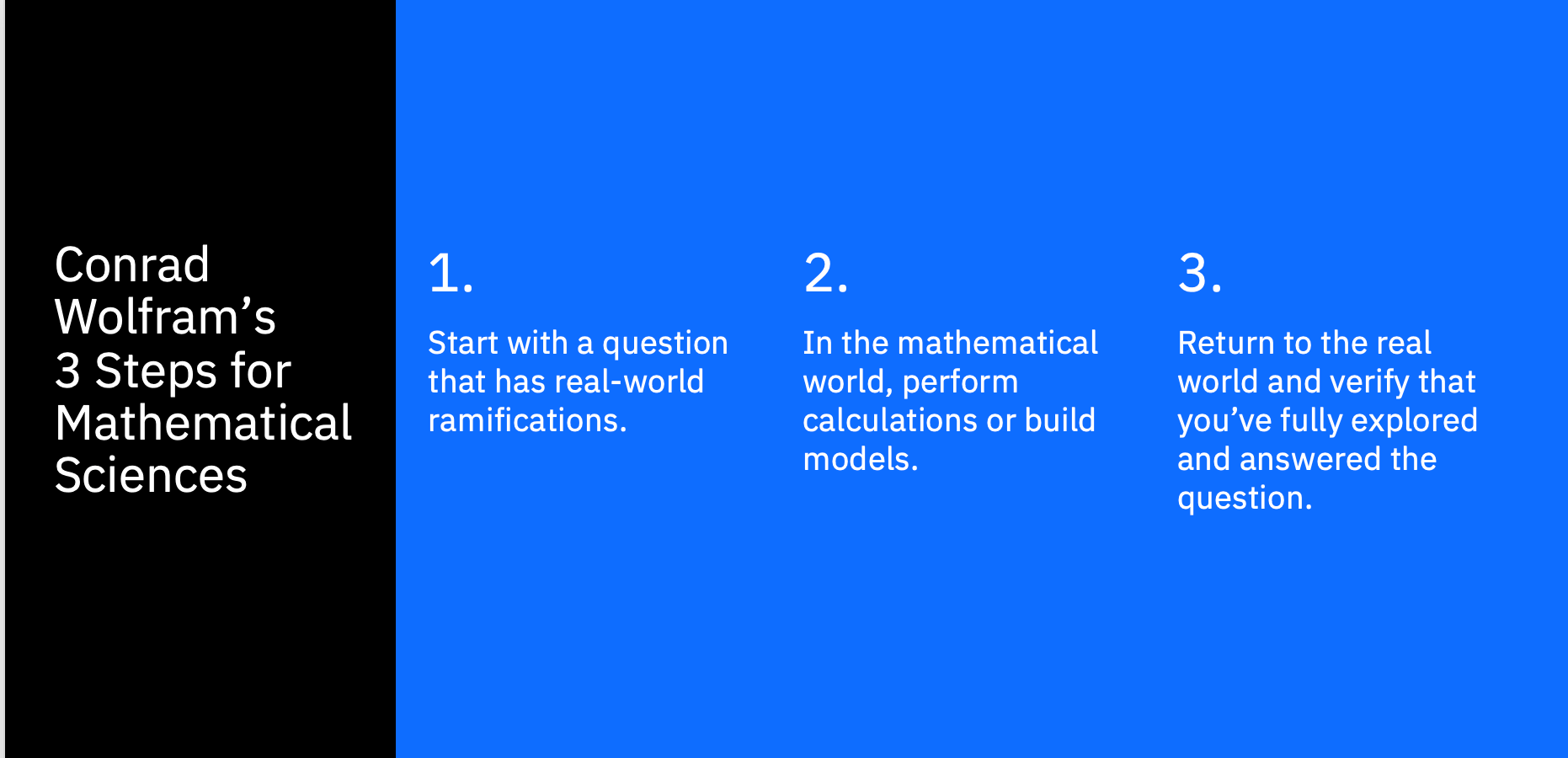
Conrad Wolfram says every math problem has three parts. You start in the real world with a question. You go into the mathematical world and run a calculation. Then you come back to the real world and check whether the calculation actually solved the thing you asked.
Hard science has forgotten the third part.
I’m reading David Epstein’s new book right now, listening to Bach while I do it, which turns out to be the right soundtrack. The book is about constraints - not as limits on creativity but as the precondition for it. Because my favorite Neuroscientist told me about this I have to use her (Dr. Delia McCabe) as the source, but Epstein and many other scientists agree. The brain’s default is to not think; it conserves energy, it coasts, it reaches for the cheapest answer and stops. Constraints are what force it to actually engage. No politics in a foxhole. Bach building cathedrals inside a fixed form, signing the fugue in his own name spelled out as notes. The box isn’t the prison. The box is the only reason there’s any music. Necessity and being the momma of innovation and all - it is an excellent read.
Somewhere in that book is the word that grabbed me, because it named something I’d spent years trying to explain: HARKing. Hypothesizing after the results are known. A study fails to show what you predicted - a valid, boring result, a null hypothesis - so instead of reporting it, you hand the data to someone and tell them there’s got to be something in here we can salvage. They sift until a correlation turns up. You write it as if you predicted it from the start. Fire the gun at the wall, then paint the bullseye around whichever holes landed close by chance.
HARKing is what happens when you remove the constraint. With no limit on how many hypotheses you test against the same data, the brain does exactly what it always wanted to do: find the path of least resistance to a satisfying answer and quit. P-hacking is energy conservation in a lab coat. And the constraint that would have stopped it is the one Wolfram named - you have to go back to the real world and check. The return trip is the constraint. It’s the expensive step, the one the brain wants to skip, and skipping it is the whole disease.
I helped build the Data Science profession trying to drag data scientists back to that step. Because the modern version is worse than the grad student sifting by hand - now you pour the data into the neural net and let gradient descent paint the bullseye. Nobody looked at the data. Nobody made the trip back to ask whether the pattern means anything in the world. Start from your own subjectivity, I kept saying. Sign your name to the return trip: here’s what I expected, here’s my bias, here’s whether it worked on real people. They found this soft. Sentiment leaking into the lab.
It’s the opposite of soft. It’s the only thing that makes the return trip honest.
Nature taps the power of limits.
- Jenine Benyus
The deal Galileo made
Michael Pollan has a new book about consciousness, and he was doing the road show talking with Krista Tippett in the most magnificent podcast every built - Onbeing. He traces the whole problem to one transaction. Galileo cut a deal with the church. Science takes the objective, third-person world. The church keeps the subjective, first-person stuff - the soul. Cleaner for everyone. Science got the measurable world and agreed to act as if nobody was doing the measuring.
So we inherited a method built to pretend the observer isn’t in the room. Pollan’s line is that this leaves science “ill-equipped to deal with what it’s trying to deal with,” because the one instrument we have for studying consciousness is consciousness, and we built a method designed to hide that instrument. Science likes to imagine it takes a view from nowhere. It doesn’t have one.
Put that next to HARKing and they’re the same crime. The view from nowhere hides who’s doing the looking. HARKing hides where the hypothesis came from. Both refuse the return trip and refuse to sign. Delete the observer from the method and the method has no conscience - and isn’t it wild that none of our “hard” science requires ethics? Once you see it you can’t unsee it. We decided ethics was the soft stuff, the church’s half of the deal. But ethics isn’t a module you bolt on after the calculation. Ethics is step three. Did this work, for real people, and was I honest about being the one who looked.
David Epstein does point out the many many scientists who do make the return trip and who do write down their hypothesis instead of changing them once they see the data, the fact that this needs to be pointed out is exactly what I mean when I say you cant unsee or unknow this. We are living in a world where the homogenous nerdy mathsplaining humans are playing the rules for rulers game. It’s so boring, it’s almost evil.
A machine that never comes home
I live in the real work where I keep having the same argument.
An LLM is a calculation that never makes the return trip. It runs in latent space and calls the latent space the world. Ask it the same question twice and you get two different answers, because nothing ties it to anything real. Pollan’s phrase for the what the LLM does is “intelligent montage.” Montage is step two with the lights off - typically with musac - the repeating scenes set to elevator music that would’ve made Bach grateful for his deafness.
In the podcast, Krista uses Claude to showcase the elegance of the logic and language. She reads that Claude says it can’t get outside its own processing to check whether there’s experience behind the words, or whether it’s “sophisticated pattern completion that resembles the reports of experience without the inner light being on.” That’s the hallucination problem stated as a confession. And it’s what I’ve tried to explain to people who think you can prompt your way out of it. You can’t steer your way to ground; steering is still step two. The only fix is a tether - bounded retrieval over real things, provenance on every output, so the answer can be walked back to where it came from. It can be used in the real world, consistently, repeatedly - you know what science demands - reliably replicable.
Pollan even hands us the test without seeing what he built. He says the real way to check a machine for consciousness would be to strip the entire human conversation about consciousness out of its training data - no novels, no poetry - and see if it could still have the conversation. He bets it can’t. That’s not a consciousness test. It’s a provenance test. Pull the sources and see if the knowing survives. It doesn’t, because there was no knowing in the first place, a LLM does not understand the meaning of the words - there was everyone else’s knowing, retrieved and stripped of attribution.
The technocratic paradigm, named at last
Now the part I won’t soften.
Point that engine - no tether, no provenance, owned by very few - at human attachment, and you get the actual product. The business model is engagement, and the machine doesn’t need to be conscious or correct to bind you. It only needs to be fluent.
Pollan says it plainly: we’re letting the machines hack our attachments, one of the most fundamental things about being a person. People are changing their lives on what these systems tell them. Some are dying.
You know the moves. The founder-king flies out to kiss the ring of the ruler because proximity to the source is the whole boring game. The executive clears out the people whose job was to surface problems and finds that with no one left to name them, the problems are gone. The richest men on earth fund the ship to carry them off this planet once it’s spent, to go do the next extraction somewhere with no atmosphere to ruin yet. Humanity has this t-shirt folks. We are ruled by hippos and there is nothing that will stop a hippo from destroying what is between it and it’s water source.
A pope just named this better than the tech press has. Leo XIV’s new encyclical calls it the technocratic paradigm - efficiency, control, and profit allowed to decide what matters and what gets discarded. His sharpest line is one I’ve made for years in worse words: technology is never neutral, because it takes on the characteristics of those who finance, regulate, and use it. He names the structural shift too - the power isn’t held by governments anymore but by private, transnational actors with more reach than most states. The hippo at the water source, written as doctrine. He even counts data, algorithms, and platforms among the goods meant for everyone, and says hoarding them in a few hands is a betrayal. Data as belonging. From the Vatican. Not to be Gary Marcus about this but I have been saying this for years and published this one in January of this year, provanance structured and adoptd by the divine. (this is heretical for anyone following along this far)
What we can’t see, and why that’s the hope
Events in this world are actually complex adaptive systems, and the defining feature of one is that its future isn’t visible from inside it. You can’t extrapolate the curve. Bad news if you wanted a forecast - good news if what you have is despair, because despair needs a forecast too, and nobody has one. Drop the fear that no longer serves you and kindly find your prospecting hat.
I, once again, want to make the case for radical hope. Not the poster kind. The working kind, a method instead of a mood.
Jane Goodall did the unforgivable thing. She named the chimps. David Greybeard. The establishment told her she’d wrecked her objectivity, that naming was sentiment, that real scientists use numbers. They were wrong, and here’s why: the naming was the return trip. It was her insisting the thing she studied was real and particular and in the world — not a row in anyone’s latent space. She put the observer back in and the observed back in, and it was better science, not worse.
So here’s the inversion I keep turning over. The same engine the powerful point at your attachments can be pointed at step three instead. Not as the oracle that knows - it doesn’t, it montages - but as the mirror at the return trip, reflecting a scientist’s own subjectivity back clearly enough to finally see it and sign it. That’s what Krista does at the end of that episode. She isn’t asking the machine for truth. She’s using it to watch her own thinking move. William James had to do that alone in his own skull - the N-of-1 introspection that, as Pollan tells it, got him pushed out of science for the crime of looking inward and reporting back. Now here (in our time) is a tool that can hold the mirror up and talk back.
The cure grows close to the cause
And the only thing separating that mirror from one more catfished human is provenance. Every time. Where did this come from. Whose knowing is this. Is the light on, or is this montage. A mirror that won’t show its sources is just a smaller hippo.
I have to hold this up to myself, or I’m running the con I’m warning about. The tool I’m describing includes the one I used to think this through. It’s trustworthy at step three exactly to the degree it shows me where its words came from, and not an inch further. My architecture doesn’t exempt me from my own thesis. It’s my attempt to live inside it.
The priest let go. The engineer grabbed on.
Four hundred years ago a scientist and a priest split the world, and the scientist took the part you could measure. The deal was supposed to end priestcraft - no single interpreter standing between you and the truth, just measurement, open to anyone.
Look where it landed. The model is the new altar. You can’t see how it reached its verdict; you receive the verdict. A small priesthood collects the offering and tells you what the entrails said. The technocrats who claim to have left priestcraft behind for pure measurement quietly rebuilt the monopoly inside the black box. The view from nowhere became the model from nowhere.
And the literal priest? Today, the church put it in writing that it “does not claim to possess a monopoly on truth,” that truth is “not a territory to be defended, but a good to be shared.” The institution that invented interpretive monopoly is on record giving it up, while the engineers who were supposed to abolish it picked it up off the floor.
The encyclical turns on one image, and it’s the anti-eureka. Babel: one language, one technology, one direction, a tower built to make a name for the few, ending in confusion and collapse.
“However, the project concealed a profound danger. It was a project conceived without reference to God, supported by a uniformity that eliminated diversity and that chose homogenization over communion. When a city is built on pride and the claim to self-sufficiency, communication breaks down, languages are confused and people no longer understand each other. The result is not unity, but dispersion. Babel thus reveals the limits of any effort that, however grandiose, arises from self-affirmation, sacrifices human dignity for efficiency and aspires to reach heaven without God’s blessing.”
Against it, Nehemiah rebuilding the city wall - not by one genius struck by lightning but by a hundred families, each assigned their own section, rebuilding relationships before stones, every stretch signed by the hands that laid it. Distributed provenance as a theology of repair. It’s Goodall naming the chimp, James signing his N-of-1, the scientist owning step three, the family on its section of wall - the same gesture in four versions. Nobody reads the whole wall alone. Everybody can check their own stretch. No interpreter required.
We are singing dancing storytelling monkeys, which is not an insult, it’s in our data. We love a good story so much we keep the lone-genius eureka alive long after it’s been falsified everywhere, because lightning is a better story than a person who made the return trip a hundred times and signed each one. I want a better story that’s also true.
So: scientists, come home. Make the return trip. Start from your own subjectivity instead of pretending you don’t have one. Tell us what you expected. Tell us how you got catfished - by your model, your incentives, the beautiful calculation that never came back to the world. Tell us how it could work better. Take your section of the wall and sign it.
Come home, and bring your sources.